
Fingram 2026-06-04 0
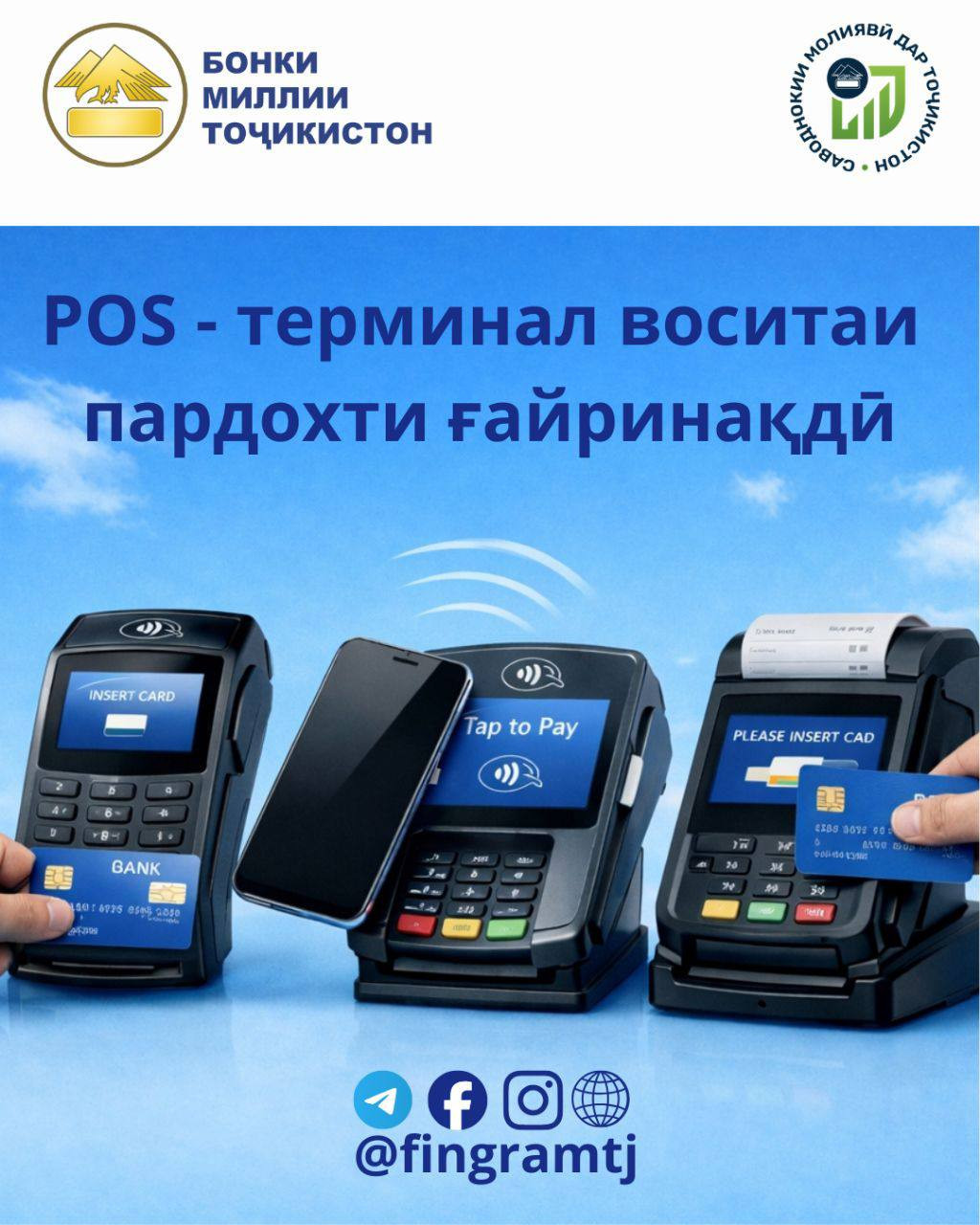
Using POS Terminals to Pay for Goods and Services
A POS (Point-of-Sale) terminal is a device used to accept payments made with bank cards and other electronic payment instruments. It is connected to the banking network and transfers funds from the customer's account to the merchant's account.
POS terminals are installed at retail and service outlets, including shops, hospitals, pharmacies, and government institutions that provide paid services to the public.
Types of POS Terminals
Depending on their functionality and method of use, there are different types of POS terminals. In the Republic of Tajikistan, two main types are commonly used: stationary POS terminals and virtual POS terminals.
1. Stationary POS Terminal — installed at retail and service locations such as shops, pharmacies, and fuel stations. It is used to accept payments made with bank payment cards.
2. Virtual POS Terminal — a service that enables cashless payments over the Internet (e-commerce) without requiring any physical terminal. Payments through a virtual POS terminal are made as follows:
the customer selects a product or service on a website or mobile application;
proceeds to the payment page;
enters the bank card number, expiration date, and the CVV/CVC security code (the three-digit code on the back of the card);
confirms the payment using a verification code (SMS or 3D Secure authentication).
Benefits of Using POS Terminals for Customers
Fast and convenient. There is no need to carry large amounts of cash or wait in line at ATMs. Contactless (NFC) payments take only 2–3 seconds.
Secure. If a bank card is lost, the funds remain safely in the customer's bank account, unlike cash. The lost card can be blocked immediately.
Bonuses and cashback. Domestic banks regularly offer cashback (a percentage of the purchase amount returned to the customer) or reward points for cashless payments made through POS terminals.
Expense tracking. Mobile banking applications provide a detailed record of all purchases, including the merchant, date, and time of each transaction.
Please log in to leave a comment.










All comments